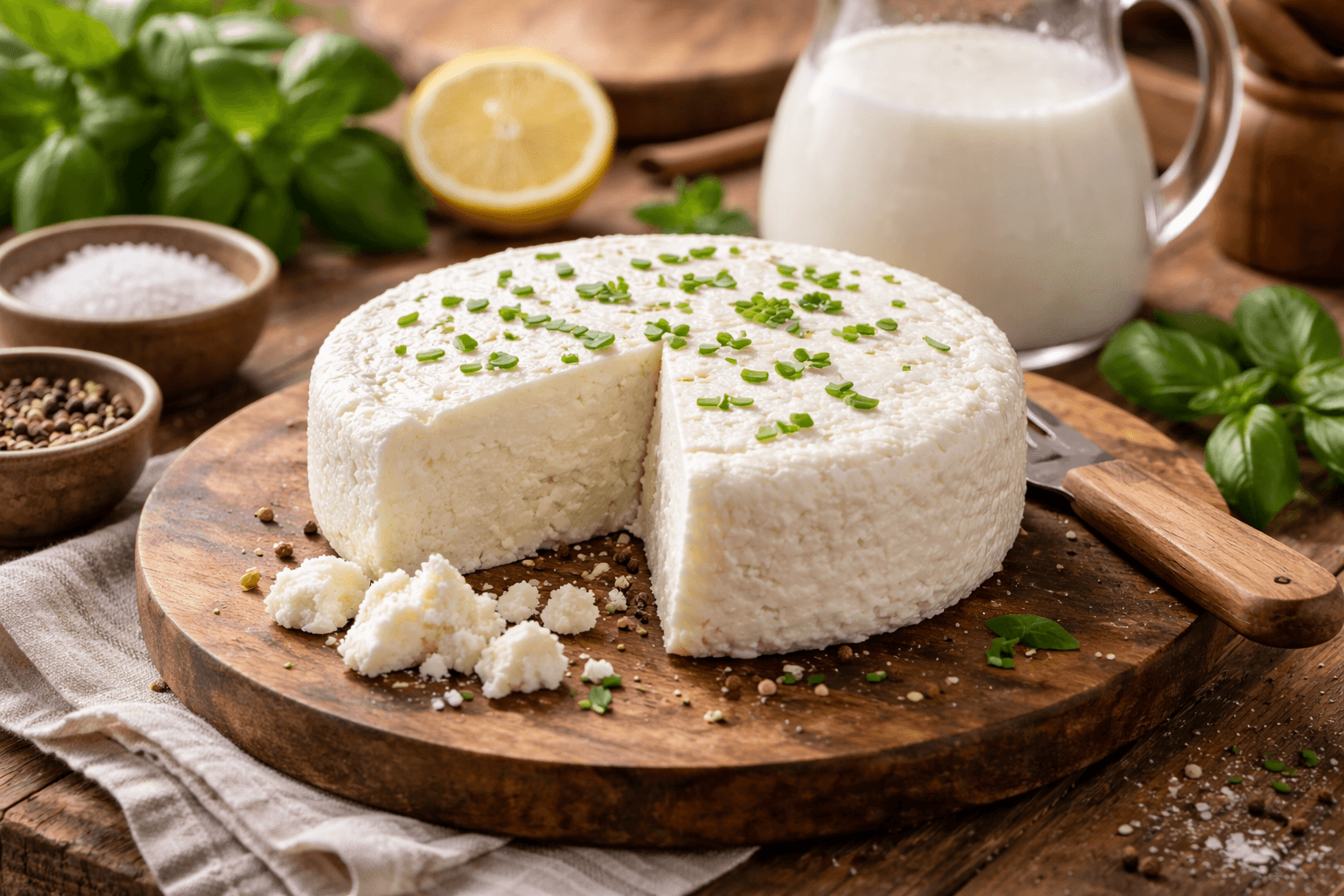
Homemade Goat Cheese Queso Fresco – Simple Step-by-Step Recipe
2026-02-28
Queso fresco is a white, fresh cheese of Spanish-Mexican origin (literally "fresh cheese"), valued for its delicate, mild flavor and crumbly, slightly grainy texture. Traditionally made from cow's milk or a blend of milks, goat milk gives it exceptional creaminess and a pleasant tang. Unlike queso blanco, queso fresco uses rennet and a bacterial culture for coagulation, which gives it a more complex flavor. The recipe below explains step by step how to prepare it at home.
Ingredients
- Fresh goat milk — about 4 liters (full-fat, pasteurized or raw; do not use ultra-pasteurized UHT milk — it will not form a curd). A cow/goat blend also works.
- Mesophilic starter culture — ¼ teaspoon dried culture or 1 tablespoon natural buttermilk (optional; can be substituted with sour cream or plain yogurt).
- Liquid rennet — about ¼ teaspoon per 4 liters of milk, dissolved in 50 ml of non-chlorinated water (filtered or bottled). Chlorine deactivates the enzyme.
- Calcium chloride — ¼ teaspoon dissolved in 50 ml of water (optional but recommended for pasteurized milk — restores the minerals needed for a firm curd).
- Salt — about 2–3% of the final cheese weight (for 4 liters of milk, roughly 1 heaping tablespoon). Optional: herbs, chili peppers, or garlic.
Equipment
- Stainless steel pot with a wide, heavy base (prevents scorching)
- Dairy thermometer (accurate in the 30–45°C / 86–113°F range)
- Wooden or silicone spoon or spatula
- Colander and double-layer cheesecloth or muslin
- Cheese mold or bowl with a weight
- Large bowl to collect whey
Preparing the Milk and Adding the Culture
Pour the milk into the pot and slowly heat to 32°C (90°F), stirring gently to distribute heat evenly. If using pasteurized milk, add the calcium chloride solution and stir gently.
Once the milk reaches 32°C, sprinkle the mesophilic culture evenly over the surface. After 2–3 minutes, stir gently. Cover the pot and hold at 32°C for 45 minutes — the culture activates and prepares the milk for coagulation.
Adding Rennet and Forming the Curd
After the incubation period, add the diluted rennet to the milk. Stir gently for about one minute, then stop stirring, cover the pot, and leave undisturbed for 40–60 minutes.
The curd is ready when a knife inserted at an angle produces a clean break — the mass splits cleanly into two parts and the whey is pale yellow, not milky. If the whey is still cloudy, wait another 10–15 minutes.
Cutting the Curd
Cut the curd with a sharp knife into a grid of 1–1.5 cm (½ inch) cubes, both vertically and horizontally. Let it rest for 5 minutes to stabilize.
Then very gently stir with a wooden spoon and gradually raise the temperature to 34–35°C (95°F). This stage — often called "cooking the curd" — lasts about 10–15 minutes. During this time the curds shrink and release more whey.
Draining the Whey and Salting
Let the curds settle to the bottom for a few minutes. Pour the contents through a colander lined with a double layer of cheesecloth into a large bowl — whey drains into the bowl.
Once most of the liquid has drained, transfer the curds to a clean bowl and add salt at about 2–3% by weight (about 1 heaping tablespoon per 4 liters of milk). Mix evenly by hand or with a spoon, cover, and let rest at room temperature for 30 minutes.
Shaping and Pressing
Transfer the curds into a cheesecloth-lined mold and fold the cloth over the top. Start with a light weight (2–3 kg / 4–6 lbs) for 30 minutes, then increase to 8–10 kg (17–22 lbs) for 2–4 hours.
Flip the cheese once during pressing and replace the cloth — this ensures an even shape. After pressing, remove the cheese from the mold and place it on a rack.
Aging and Storage
Queso fresco does not require aging — you can eat it immediately after removing it from the mold. It will have a mild, slightly tangy flavor and a soft texture.
Store in the refrigerator, loosely wrapped in parchment paper or in an airtight container for up to 5–7 days. For longer storage, submerge the cheese in brine (1 tablespoon of non-iodized salt per cup of water) — it will keep for 10–14 days. Do not freeze queso fresco — it becomes crumbly and grainy after thawing.
Uses and Tips
Flavor profile: Fresh queso fresco is mild and creamy, with a delicate lactic tang. It does not melt when heated — instead it softens and browns lightly. Crumble it over finished dishes: salads, tacos, enchiladas, soups, or roasted vegetables.
Add-ins: Just before pressing, fold in finely chopped dried herbs, garlic, or chili peppers (e.g., jalapeño). Since most of the whey has drained, the flavors will stay in the curd. Good combinations: mint + lemon zest, dill + garlic, thyme + rosemary, toasted cumin + black pepper.
Rennet types: For beginners, microbial (vegetarian) rennet is the easiest starting point — shelf-stable and consistently dosed. Animal rennet produces a slightly cleaner flavor and firmer curd. Never dissolve rennet in tap water — chlorine deactivates it.
What to Do With the Leftover Whey
Whey is a valuable by-product — do not pour it away:
- Bake with it — replace water with whey in bread, pancake, or waffle recipes for extra flavor and nutrition,
- Make ricotta — heat whey to 85–90°C (185–195°F), add a splash of lemon juice, and collect the proteins that rise to the surface,
- Water plants — diluted 1:4 with water, mildly acidic whey is great for blueberries, tomatoes, and roses,
- Freeze it — in sealed containers for up to 6 months.
Common Beginner Mistakes
- Using UHT milk — high-temperature pasteurization destroys protein structure; the curd will not form,
- Tap water to dilute rennet — chlorine deactivates the enzyme; always use filtered or bottled water,
- Too much rennet — the curd becomes rubbery and bitter; more is not better,
- Cutting the curd too early — cloudy whey and a fragile curd; always check for a clean break first,
- Under-salting — the cheese tastes bland, spoils faster, and stays too wet.